
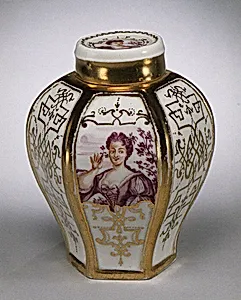
Caddy with cover
ca. 1740
Medium
Hard-paste porcelain
Dimensions
Height: 4 in. (10.2 cm)
Classification
Ceramics-Porcelain
Culture
German, Augsburg
Department
European Sculpture and Decorative Arts
Museum
Metropolitan Museum of Art, New York, NY
Credit
Gift of R. Thornton Wilson, in memory of Florence Ellsworth Wilson, 1950
Accession Number
50.211.241a, b
Rights
Public Domain
Tags
Art Historical Context
This delicate *Caddy with Cover* by Abraham Seuter, crafted around 1740, exemplifies the exquisite hard-paste porcelain production from Augsburg, Germany—a hub of decorative arts in the 18th century. Standing just 4 inches tall, this petite lidded container was likely designed to hold precious tea leaves, the rising popularity of tea drinking among Europe's elite during the Rococo era.uter's mastery as a porcelain painter shines through in its finely painted portraits of women, capturing the elegance and poise of fashionable sitters with vibrant enamels. Hard-paste porcelain, pioneered in nearby Meissen but perfected in Augsburg workshops, allowed for translucent, durable bodies ideal for intricate overglaze decoration. Seuter, a leading enameler (active ca. 1720–1760), employed meticulous techniques like polychrome painting and gilding to bring these intimate portraits to life, blending technical precision with artistic flair. Such caddies were coveted luxury items, symbolizing status and the cross-cultural exchange of tea from Asia to European tables. Housed in The Metropolitan Museum of Art's European Sculpture and Decorative Arts collection (gift of R. Thornton Wilson, 1950), this piece highlights Augsburg's role in democratizing porcelain artistry beyond royal courts, offering a glimpse into 18th-century domestic refinement and the era's fascination with female portraiture.