
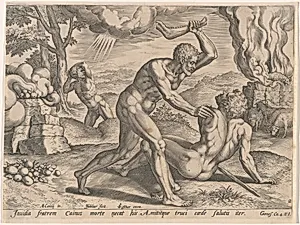
Cain Killing Abel
Medium
engraving on laid paper
Dimensions
plate: 20.5 × 27.6 cm (8 1/16 × 10 7/8 in.) sheet: 21 × 27.8 cm (8 1/4 × 10 15/16 in.), trimmed within platemark on left
Classification
Department
CG-E
Museum
National Gallery of Art, Washington, D.C.
Credit
Gift of Ramon Osuna
Accession Number
2018.209.5
Rights
Public Domain
Art Historical Context
In the National Gallery of Art's print collection, *Cain Killing Abel* (1576) is a striking engraving by Flemish artist Jan Sadeler I, faithfully reproducing a design by Michael de Coxcij. This dramatic biblical scene from Genesis captures the moment of fratricide, Cain slays his brother Abel in a fit of jealousy over God's favor. Sadeler, part of a renowned family of engravers, masterfully translates Coxcij's composition—likely from a painting—into intricate lines on laid paper, measuring about 20.5 × 27.6 cm. Engraving, a precise intaglio technique where metal plates are incised and inked, allowed for detailed reproductions that could be widely distributed during the Northern Renaissance. Produced amid religious upheavals in the Spanish Netherlands, such prints served as affordable aids for moral and devotional instruction, bringing vivid Old Testament narratives into homes and churches. The trimmed sheet edges hint at its handling over centuries, underscoring the durability of this medium. This work exemplifies 16th-century reproductive printmaking's role in disseminating artistic ideas across Europe. A generous gift from Ramon Osuna, it invites visitors to reflect on timeless themes of envy and violence, rendered with Sadeler's characteristic finesse in shading and expression.