
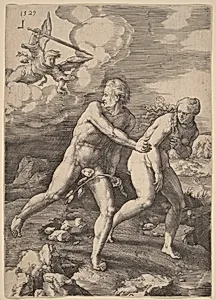
The Explusion from Paradise
1529
Medium
engraving
Classification
Department
CG-E
Museum
National Gallery of Art, Washington, D.C.
Credit
Rosenwald Collection
Accession Number
1943.3.5666
Rights
Public Domain
Art Historical Context
### The Expulsion from Paradise Step into the intricate world of Lucas van Leyden's *The Expulsion from Paradise (1529), a masterful engraving housed in the National Gallery of's Rosenwald Collection. This poignant print captures the biblical moment when Adam and Eve are driven from the Garden of Eden by a stern angel wielding a flaming sword—a dramatic scene rich with emotion and moral weight from Genesis. Lucas van Leyden, a prodigious Dutch artist of the Northern Renaissance (1494–1533), was renowned for his virtuoso engravings, which rivaled the works of Albrecht Dürer in their fine detail and narrative depth. Working on a copper plate, van Leyden incised precise lines to create texture, shadow, and movement, a technique that allowed for multiple impressions and broad dissemination of complex stories to a wider audience beyond elite patrons. As a prime example of early 16th-century printmaking, this work highlights the era's fascination with religious themes and human frailty, blending meticulous observation of nature with symbolic storytelling. Visitors will appreciate its technical brilliance and timeless reminder of paradise lost—perfect for contemplating the artistry of the Reformation age. (178 words)
About the Artist
Lucas van Leyden · 1484–1533
Lucas van Leyden (1494–1533) was a Dutch painter and printmaker who stands among the greatest engravers of the Northern Renaissance. Born in Leiden as either Lucas Hugensz or Lucas Jacobsz, he lived and worked primarily in his native city, achieving international renown that rivaled the German master Albrecht Dürer. Lucas van Leyden revolutionized Netherlandish printmaking and was among the first...