
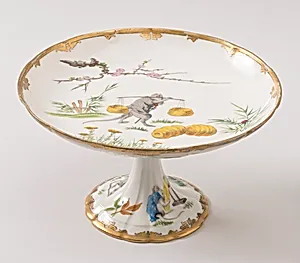
cakestand
Classification
ceramics
Department
Smithsonian Collection
Museum
Smithsonian American Art Museum
Credit
Museum purchase through bequest of Dona Guimaraes and from Decorative Arts Association Acquisition Fund
Accession Number
1993-124-7
Rights
Public Domain
About this artwork
Research in Progress
Art Historical Context
Step into the refined world of 19th-century French tableware with this elegant *cakestand* fromivuyt & Cie, a esteemed porcelain manufacturer established around 1818 in Bernay, Normandy. Dating to circa 1880, ceramic piece exemplifies the firm's reputation for producing high-quality, durable porcelain for everyday luxury. Pillivuyt & Cie specialized in finely crafted dinnerware and serving items, blending industrial precision with neoclassical elegance, which made their products popular across Europe and America during the Victorian era. Cake stands like this one were essential for the rising ritual of afternoon tea, a social custom that flourished in the late 1800s. They allowed hosts to display layered cakes and pastries with graceful poise, reflecting the era's emphasis on hospitality and visual splendor. As a ceramic object, it highlights advancements in porcelain production—using kaolin clay fired at high temperatures for translucency and strength—techniques that revolutionized table arts and made fine dining accessible beyond aristocracy. Acquired through a museum purchase funded by the bequest of Dona Guimaraes and the Decorative Arts Association Acquisition Fund, this cakestand now graces the Smithsonian American Art Museum's collection. Though research continues, it offers a tangible glimpse into the cultural interplay of design, commerce, and daily life in Gilded Age households.