
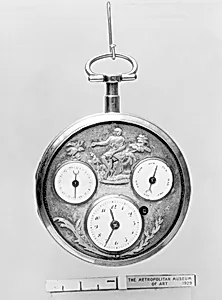
Calendar watch
ca. 1795
Medium
Gold, silver-gilt, enamel
Dimensions
Diameter: 2 in. (5.1 cm)
Classification
Horology
Culture
French, Rouen
Department
European Sculpture and Decorative Arts
Museum
Metropolitan Museum of Art, New York, NY
Credit
Bequest of Laura Frances Hearn, 1917
Accession Number
17.101.21
Rights
Public Domain
Tags
Art Historical Context
This exquisite *Calendar watch* by the Rouen watchmaker Blainville dating to around 1795, exemplifies the pinnacle of French horology during the late 18th century. Craft from gold with silver-gilt elements and delicately painted enamel, the compact 2-inch-diameter timepiece served not just to tell time but to display the full calendar—day, date, and month—through intricate mechanical complications. Such watches were marvels of engineering, blending precision craftsmanship with opulent decoration, and were prized possessions of the French elite amid the post-Revolutionary Directory period. The enamel scenes adorning the watch, featuring graceful women amid lush trees, evoke the pastoral idylls popular in Revolutionary-era decorative arts. Enameling, a technique involving finely ground glass fused to metal at high temperatures, allowed for vibrant, durable miniature paintings that captured the Rococo-to-Neoclassical transition. Rouen's tradition of luxury metalwork shines here, transforming a functional object into wearable art. Housed in the Metropolitan Museum of Art's European Sculpture and Decorative Arts department, this watch—bequeathed by Laura Frances Hearn in 1917—highlights how horology intertwined science, artistry, and status, offering a glimpse into the refined tastes of 1790s France. Visitors, imagine slipping this jewel into your pocket as a subtle emblem of sophistication!