
Camel
Unknown Artist
first half 12th century (possibly 1129–34)
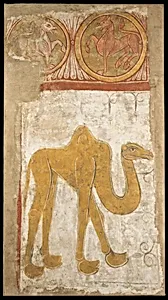
Medium
Fresco transferred to canvas
Dimensions
Overall: 97 x 53 1/2 in. (246.4 x 135.9 cm)
Classification
Paintings-Fresco
Culture
Spanish
Department
The Cloisters
Museum
Metropolitan Museum of Art, New York, NY
Credit
The Cloisters Collection, 1961
Accession Number
61.219
Rights
Public Domain
Tags
Art Historical Context
This striking fresco of a camel, created in Spain during the first half of the 12th century, offers a vivid glimpse into Romanesque art of the medieval period. Likely painted between 1129 and 1134, the work once adorned the walls of a church or monastic building before being carefully transferred to canvas for preservation. Now housed in The Cloisters at The Metropolitan Museum of Art, it exemplifies the museum’s renowned collection of medieval European art, where such monumental wall paintings provide insight into the visual culture of the time. The large scale—nearly eight feet tall—highlights the ambitious nature of fresco technique, in which pigments are applied directly onto wet plaster to create durable, luminous images integrated with architecture. Though the artist remains unknown, the subject of a camel stands out as an exotic motif in Spanish Romanesque art, possibly reflecting connections to pilgrimage routes, trade, or symbolic imagery drawn from biblical narratives. Visitors today can appreciate how this work bridges distant worlds, capturing both the artistic skill of medieval Spain and the enduring fascination with creatures from faraway lands.