
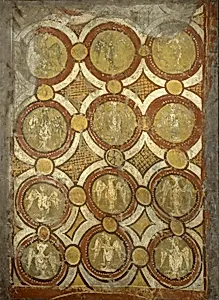
Decorative Panel with Eagles
Unknown Artist
first half 12th century (possibly 1129–34)
Medium
Fresco transferred to canvas
Dimensions
Overall: 60 7/8 x 44 1/4 in. (154.6 x 112.4 cm)
Classification
Paintings-Fresco
Culture
Spanish
Department
The Cloisters
Museum
Metropolitan Museum of Art, New York, NY
Credit
The Cloisters Collection, 1957
Accession Number
57.97.6
Rights
Public Domain
Tags
Art Historical Context
This striking fresco, created in the first half of the twelfth century, offers a vivid glimpse into medieval Spanish art. Likely painted around 1129–34, the panel once adorned the walls of a Spanish church or monastery before being carefully transferred to canvas for preservation. Now housed in The Cloisters, the Metropolitan Museum’s dedicated space for medieval art, it exemplifies the Romanesque period’s emphasis on bold, symbolic decoration within sacred spaces. The unknown artist employed the traditional fresco technique, applying pigments directly onto wet plaster to create durable, luminous images. The composition features eagles, powerful symbols often associated with strength and divine vision in medieval Christian imagery. Measuring nearly five feet tall, the panel’s scale suggests it formed part of a larger decorative program designed to inspire and educate worshippers. Acquired by the museum in 1957, this work highlights the enduring appeal of Romanesque frescoes and their role in bridging architecture, painting, and spiritual meaning during a transformative era in European history.