
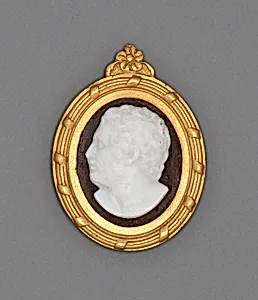
Cameo with Head of a Man
Late 18th century
Medium
Stoneware (jasperware)
Dimensions
4.9 × 4.8 × 0.5 cm (1 15/16 × 1 7/8 × 3/16 in.)
Classification
cameo (sculpture)
Department
Applied Arts of Europe
Museum
Art Institute of Chicago
Accession Number
67846
Rights
Public Domain
Art Historical Context
This delicate cameo, produced by the Wedg Manufactory in the late 18th century, captures the refined taste its era through its compact form and classical profile. Measuring just under two inches across, the piece was likely intended as a decorative ornament for furniture, jewelry, or personal accessories. Its classification as a cameo highlights the enduring appeal of ancient Roman and Greek portrait medallions, which enjoyed renewed popularity during this period. Wedgwood’s signature jasperware medium allowed artisans to create crisp white reliefs against a colored stoneware ground, achieving a look reminiscent of carved gemstones at a fraction of the cost. The subtle modeling of the man’s head demonstrates the factory’s technical mastery in molding and firing, making high-style classical imagery accessible to a broader audience beyond aristocratic collectors. Today, this intimate work in the Art Institute of Chicago’s Applied Arts of Europe collection offers visitors a tangible connection to Enlightenment-era design, where industrial innovation met timeless aesthetic ideals.
About the Artist
Wedgwood Manufactory
Wedgwood Manufactory, founded on 1 May 1759 by Josiah Wedgwood in Burslem, Staffordshire, England, revolutionized ceramics during the Industrial Revolution. Born into a family of potters, Josiah apprenticed under his elder brother Thomas at the Churchyard Works from age 14, mastering traditional techniques before partnering with Thomas Whieldon from 1754 to 1759, where he honed innovative glazes. ...