
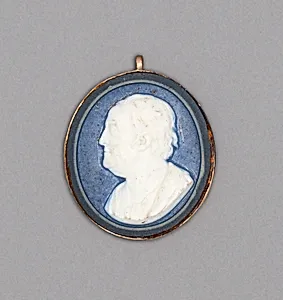
Cameo with Portrait of Benjamin Franklin
Late 18th century
Medium
Stoneware (jasperware)
Dimensions
2.7 × 2.2 × 0.8 cm (1 1/16 × 7/8 × 5/16 in.)
Classification
cameo (sculpture)
Department
Applied Arts of Europe
Museum
Art Institute of Chicago
Accession Number
67927
Rights
Public Domain
Art Historical Context
This exquisite cameo, produced by the renowned Wedgwood Manuf in the late 18 century, captures the likeness of Benjamin Franklin in finely sculpted white relief against a deep blue jasperware background. Measuring just 2.7 × 2.2 × 0.8 cm, this tiny stoneware sculpture exemplifies Josiah Wedgwood's revolutionary, which mimicked the ancient Roman cameos prized by collectors during the Neoclassical revival. Wedgwood's jasperware, an unglazed fine stoneware developed in the 1770s, allowed for intricate, matte-surfaced portraits that echoed classical gems but were produced in multiples for a wider audience. Franklin, the American polymath and diplomat, became a European celebrity after his time in France during the Revolutionary era, inspiring such commemorative objects that bridged Enlightenment ideals across the Atlantic. Housed in the Art Institute of Chicago's Department of Applied Arts of Europe, this cameo highlights Wedgwood's role in democratizing luxury ceramics, blending artistry with industrial innovation to celebrate global icons like Franklin. A testament to 18th-century transatlantic cultural exchange!
About the Artist
Wedgwood Manufactory
Wedgwood Manufactory, founded on 1 May 1759 by Josiah Wedgwood in Burslem, Staffordshire, England, revolutionized ceramics during the Industrial Revolution. Born into a family of potters, Josiah apprenticed under his elder brother Thomas at the Churchyard Works from age 14, mastering traditional techniques before partnering with Thomas Whieldon from 1754 to 1759, where he honed innovative glazes. ...