
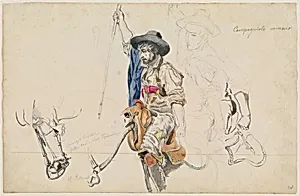
Campagniolo romano
c. 1833
Medium
watercolor over graphite on laid paper from a ledger book (ruled in red)
Dimensions
sheet: 27.8 x 42.7 cm (10 15/16 x 16 13/16 in.)
Classification
Drawing
Department
CG-E
Museum
National Gallery of Art, Washington, D.C.
Credit
Wolfgang Ratjen Collection, Purchased as the Gift of Andrea Woodner
Accession Number
2007.111.22
Rights
Public Domain
Art Historical Context
Friedrich Nerly’s “Campagniolo romano,” created around 1833, captures the quiet beauty of the Roman countryside during a period when many European artists traveled to Italy in search of inspiration. The title evokes the rolling landscapes and ancient ruins of the Campagna, a region that held deep romantic appeal for 19th-century travelers. Rendered in delicate watercolor washes over graphite, the drawing reflects the era’s fascination with direct observation of nature and atmospheric effects. The choice of support is especially intriguing: Nerly worked on laid paper taken from a ledger book, its red ruling still faintly visible. This practical reuse of everyday material highlights the spontaneous, portable nature of such studies, allowing artists to sketch quickly while journeying through Italy. The combination of graphite underdrawing and transparent watercolor gives the scene both structure and luminous color, inviting viewers to sense the soft light and open horizons of the Roman plain. Today the sheet forms part of the National Gallery of Art’s Wolfgang Ratjen Collection, where it offers visitors a glimpse into the working methods of Northern European artists abroad. Its modest scale and intimate handling remind us that many enduring impressions of Italy began as small, personal records made on the spot.
About the Artist
Friedrich Nerly · 1807–1878
**Friedrich von Nerly** (originally Christian Friedrich Nehrlich, 1807–1878) was a German Romantic painter best known for his luminous vedute of Venice, where he spent most of his adult life. Born in Erfurt to a postal official who died young, he moved at age eight to Hamburg to live with relatives. There he received early drawing instruction from his aunt and later from his uncle, the lithographe...