
Camprodón, Spain
c. 1892
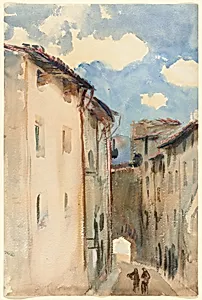
Medium
transparent and opaque watercolor on wove paper
Dimensions
sheet: 46.7 × 31.2 cm (18 3/8 × 12 5/16 in.)
Classification
Drawing
Department
CG-W
Museum
National Gallery of Art, Washington, D.C.
Credit
Ailsa Mellon Bruce Collection
Accession Number
1970.17.170
Rights
Public Domain
Art Historical Context
John Singer Sargent’s *Camprodón, Spain* captures a quiet moment in a Spanish hill town around 1892. Created during one of the artist’s many European travels, the work reflects his lifelong fascination with light, architecture, and the atmosphere of places off the usual tourist path. Though best known for his grand oil portraits, Sargent turned frequently to watercolor on his journeys, using the medium to record fleeting impressions with remarkable speed and sensitivity. The sheet combines transparent washes with opaque touches, allowing Sargent to suggest both the soft haze of distant mountains and the crisp edges of sunlit buildings. Painted on wove paper, the work demonstrates the fluid, layered technique he perfected in the 1890s. These watercolors were not mere sketches but independent statements, prized by collectors for their freshness and immediacy. Acquired by the National Gallery of Art through the Ailsa Mellon Bruce Collection, *Camprodón, Spain* offers visitors a glimpse of Sargent’s private travels and his mastery of watercolor as a serious artistic vehicle.
About the Artist
John Singer Sargent · 1856–1925
John Singer Sargent, born on January 12, 1856, in Florence to American expatriate parents FitzWilliam Sargent, an eye surgeon and medical illustrator, and Mary Newbold Singer, an amateur artist, enjoyed a nomadic childhood across Europe. His mother nurtured his artistic inclinations with sketchbooks and museum visits, while he received early watercolor lessons from German landscape painter Carl We...