
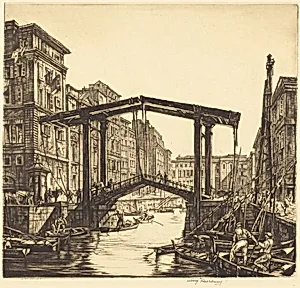
Canal de la Douane, Marseilles
1923
Medium
drypoint in black
Dimensions
plate: 22 × 23.3 cm (8 11/16 × 9 3/16 in.)
Classification
Department
CG-W
Museum
National Gallery of Art, Washington, D.C.
Credit
Rosenwald Collection
Accession Number
1943.3.7518
Rights
Public Domain
Art Historical Context
Henry Rushbury's *Canal de la Douane,illes* (1923) captures a quiet moment along the customs canal in the bustling port city of Marseille, France. prominent British printmaker and draughtsman associated with the New English Art Club,bury was renowned for his meticulous depictions of urban landscapes and architecture, often drawing inspiration from his travels across Europe. Created in the interwar period, this work reflects the era's fascination with industrial harbors and everyday scenes, evoking a sense of poised tranquility amid post-World War I recovery. Executed in drypoint—a direct intaglio technique where the artist scratches lines into a copper plate with a sharp needle—the print produces richly textured, velvety lines thanks to the burr (raised metal edge) formed during incising. This medium, popular among early 20th-century printmakers like Whistler and his followers, allowed for subtle tonal variations and an intimate, painterly quality in small-scale works like this 22 × 23.3 cm plate. Rushbury's precise handling highlights the canal's reflective waters and architectural details, showcasing his skill in translating observation into evocative monochrome. Housed in the National Gallery of Art's Rosenwald Collection, this print exemplifies the revival of fine printmaking as an accessible art form. Visitors will appreciate how it freezes a slice of Marseille's maritime heritage, inviting contemplation of a bygone industrial rhythm.
About the Artist
Henry Rushbury · 1889–1968
Henry Rushbury was a British artist celebrated primarily for his etchings and watercolors of architectural subjects, working during the early and middle decades of the twentieth century. He studied at the Birmingham School of Art before moving to London, where he became part of a generation of printmakers who revitalized the etching medium in Britain during the years surrounding the First World Wa...