
Canal with an Angler and Two Swans
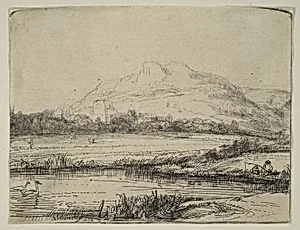
Medium
Etching and drypoint; second state of two
Dimensions
Sheet (Trimmed): 3 1/4 × 4 1/4 in. (8.3 × 10.8 cm)
Classification
Prints
Department
Drawings and Prints
Museum
Metropolitan Museum of Art, New York, NY
Credit
H. O. Havemeyer Collection, Bequest of Mrs. H. O. Havemeyer, 1929
Accession Number
29.107.14
Rights
Public Domain
Tags
Art Historical Context
In 1650, during the Dutch Golden Age, Rembrandt vanijn created *Canal with an Ang and Two Swans*, masterful etching and drypoint measuring just 3¼ × 4¼ inches. This intimate second-state work captures a serene Dutch canal scene: a lone fisherman casting his line, flanked by elegant swans gliding on the water, evoking the everyday tranquility of 17th-century Holland. Rembrandt, a pioneer of printmaking, blended etching's precise lines—etched with acid on a copper plate—with drypoint's velvety burrs, scratched directly into the metal for rich, textured depth and luminous effects. These small-scale landscapes were innovative for their time, showcasing Rembrandt's ability to convey atmosphere and subtle light in a format suited for collectors. Amid Amsterdam's booming trade and canal culture, such scenes celebrated the nation's watery world and quiet leisure pursuits like fishing, reflecting a growing appreciation for nature in art. Rembrandt's etchings, often reworked in states like this one, allowed him to refine details, enhancing tonal contrasts and emotional resonance. Today, this gem resides in The Metropolitan Museum of Art's Drawings and Prints department, part of the esteemed H. O. Havemeyer Collection (1929 bequest). It exemplifies Rembrandt's enduring legacy in printmaking, inviting viewers to savor the poetry of the ordinary.
About the Artist
Rembrandt (Rembrandt van Rijn) · 1606–1669
Rembrandt Harmenszoon van Rijn (1606–1669) stands as one of the greatest visual artists in the history of Western art and the most important Dutch painter of the 17th century. Born in Leiden to a prosperous miller's family, Rembrandt transformed painting through his revolutionary use of light and shadow, his psychological depth in portraiture, and his elevation of etching to a fine art. His approx...