
Canary and wisteria
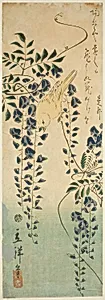
Medium
Color woodblock print; chutanzaku
Dimensions
35.8 × 12.2 cm (14 × 4 1/4 in.)
Classification
woodblock print
Department
Arts of Asia
Museum
Art Institute of Chicago
Accession Number
26000
Rights
Public Domain
Art Historical Context
Created in 1865 by Utagawa Hiroshige II, also known as Shigenobu, *Canary and Wisteria* exemplifies the refined beauty of late Edo-period ukiyo-e. As the adopted son and artistic heir of the celebrated Hiroshige I, the younger artist carried forward the master’s lyrical approach to nature while developing his own delicate touch. This color woodblock print, rendered in the narrow chutanzaku format, captures a canary perched among cascading wisteria blooms—a classic *kachō-e* (bird-and-flower) subject prized for its seasonal poetry and quiet elegance. Woodblock printing allowed Hiroshige II to layer translucent colors and fine line work, producing the soft gradations seen in the petals and feathers. Such prints were affordable souvenirs for townspeople and travelers, yet they also traveled abroad, shaping Western perceptions of Japanese aesthetics during the opening of Japan to international trade. Today, this intimate work in the Art Institute of Chicago’s collection invites viewers to pause and appreciate the fleeting harmony between bird, blossom, and season.
About the Artist
Utagawa Hiroshige II (Shigenobu) · 1826–1869
Utagawa Hiroshige II, born Suzuki Chinpei in 1826, was one of the most accomplished ukiyo-e artists of mid-nineteenth century Japan. He entered the studio of the celebrated landscape master Utagawa Hiroshige I — known for his iconic series "The Fifty-three Stations of the Tokaido" — and proved himself the most talented of the elder artist's few students. So highly regarded was the young pupil that...