
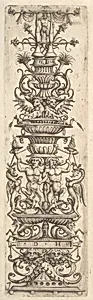
Candelabra grotesque
ca. 1485–1536
Medium
Etching; second state
Dimensions
sheet: 11 5/16 x 3 9/16 in. (28.8 x 9 cm) plate: 10 13/16 x 3 1/16 in. (27.5 x 7.8 cm)
Classification
Prints|Ornament & Architecture
Department
Drawings and Prints
Museum
Metropolitan Museum of Art, New York, NY
Credit
Bequest of Phyllis Massar, 2011
Accession Number
2012.136.735
Rights
Public Domain
Tags
Art Historical Context
Daniel Hopfer’s *Candelabra Grotesque* exemplifies the inventive spirit of early sixteenth-century German printmaking. Working in Augsburg around 1500–1536, Hopfer was among the first artists to adapt etching—a technique then used mainly for decorating armor—to create independent works on paper. The vertical composition presents an imaginary candelabrum sprouting with fantastical creatures, scrolling foliage and hybrid figures, all rendered in delicate, precise lines that reveal the medium’s capacity for intricate detail. Grotesque ornament, inspired by ancient Roman wall paintings rediscovered during the Renaissance, enjoyed widespread popularity across Europe. Hopfer’s version transforms these classical motifs into a Northern European idiom, blending playful invention with architectural symmetry. As a print in its second state, the sheet would have served both as a collector’s object and as a model for craftsmen working in metal, wood, or stucco. Today housed in the Metropolitan Museum’s Department of Drawings and Prints, this etching highlights how Renaissance artists used new reproductive technologies to circulate ornamental ideas, influencing decorative arts for generations.
About the Artist
Daniel Hopfer · 1471–1536
Daniel Hopfer (c. 1470–1536), born in Kaufbeuren, was the son of the painter Bartholomäus Hopfer and Anna Sendlerin. He relocated early to Augsburg, becoming a citizen and master painter there in 1493, and trained as an etcher of armor in this thriving center of arms production. By 1505, he owned a house in the city center and served on the guild committee for smiths, which encompassed painters an...