
Candelabrum
porcelain ca. 1725, mounts 1745–49
Medium
Hard-paste porcelain, gilt bronze
Dimensions
Height: 11 3/4 in. (29.8 cm)
Classification
Ceramics-Porcelain
Culture
German, Meissen with French mounts
Department
European Sculpture and Decorative Arts
Museum
Metropolitan Museum of Art, New York, NY
Credit
The Lesley and Emma Sheafer Collection, Bequest of Emma A. Sheafer, 1973
Accession Number
1974.356.401
Rights
Public Domain
Tags
Art Historical Context
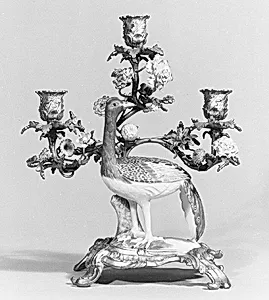
This elegant candelabrum, by the renowned Meissen Manufactory, the pinnacle of early 18th-century European artistry. Dating to around 1725 for its hard-paste porcelain body adorned with gilt bronze mounts added between 1745 and 1749, the piece stands just 11¾ inches tall. Featuring intricate motifs of peacocks and flowers, it served as a luxurious table ornament, blending delicate sculptural forms with functional candle holders. Meissen, established in 1710 near Dresden, Germany, revolutionized the decorative arts as Europe's first producer of true hard-paste porcelain—a durable, translucent material that rivaled prized Chinese imports. This innovation fueled the Rococo taste for ornate, naturalistic designs among Europe's aristocracy. The French mounts, likely from a Parisian bronzier, highlight the era's international luxury trade, where German ceramics met sophisticated French gilding for heightened opulence. Housed in The Metropolitan Museum of Art's European Sculpture and Decorative Arts Department as part of The Lesley and Emma Sheafer Collection, this candelabrum captures the cultural prestige of porcelain as a status symbol, evoking the lavish candlelit salons of the Enlightenment age.
About the Artist
Meissen Manufactory · 1710–present
The Meissen Manufactory, established on June 6, 1710, by Augustus the Strong, Elector of Saxony and King of Poland, marked the dawn of true hard-paste porcelain production in Europe. Nestled at Albrechtsburg Castle in Meissen near Dresden, the Royal Polish and Electoral Saxon Porcelain Manufactory arose from alchemical experiments begun in 1708 by physicist Ehrenfried Walther von Tschirnhaus and p...