
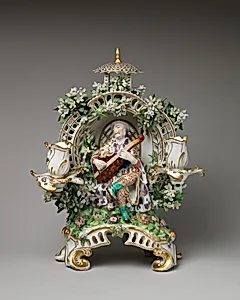
Candelabrum (one of a pair)
ca. 1765
Medium
Soft-paste porcelain
Dimensions
wt confirmed: 13 5/8 in., 6.7 lb. (34.6 cm, 3.1 kg)
Classification
Ceramics-Porcelain
Culture
British, Chelsea
Department
European Sculpture and Decorative Arts
Museum
Metropolitan Museum of Art, New York, NY
Credit
Bequest of John L. Cadwalader, 1914
Accession Number
14.58.91
Rights
Public Domain
Tags
Art Historical Context
This exquisite candelabrum, one of a pair crafted by the renowned Chelsea Porcelain Manuf around 1765, the height of British ceramic artistry during the mid-18th century. Made from soft-paste porcelain—a, translucent material that mimicked prized Chinese hard-paste porcelain but allowed for finer modeling and vibrant enameling—the piece stands 13⅝ inches tall and weighs 6.7 pounds. Chelsea, active from the 1750s to 1769, was among England's pioneering porcelain factories, producing luxurious objects for the aristocracy amid a craze for exotic imports. Adorned in the whimsical Chinoiserie style, the candelabrum features lively scenes of musicians and men with guitars, blending European Rococo exuberance with imagined Chinese motifs. This fashionable aesthetic, popular in Georgian Britain, reflected a cultural fascination with the Orient, often romanticized through playful, asymmetrical designs. The intricate figural modeling and gilding highlight the manufactory's technical mastery, transforming functional lighting into sculptural decoration. Now housed in the Metropolitan Museum of Art's European Sculpture and Decorative Arts Department, thanks to the 1914 bequest of John L. Cadwalader, this candelabrum offers a glimpse into opulent 18th-century interiors, where porcelain bridged art and everyday elegance.
About the Artist
Chelsea Porcelain Manufactory · 1744–1784
**Chelsea Porcelain Manufactory** The Chelsea Porcelain Manufactory, Britain's pioneering porcelain enterprise, was founded around 1743 in Chelsea, London, by two Huguenot silversmiths: Nicholas Sprimont from Liège and Charles Gouyn. Sprimont, trained in Paris as a goldsmith before immigrating to England, brought his expertise in luxury metalwork to the venture, while Gouyn handled early sales th...