
Candlestick
Unknown Artist
first half 14th century
Medium
Brass; inlaid with silver
Dimensions
H. 13 in. (33 cm) Max. Diam 11 1/8 in. (28.3 cm)
Classification
Metal
Department
Islamic Art
Museum
Metropolitan Museum of Art, New York, NY
Credit
Edward C. Moore Collection, Bequest of Edward C. Moore, 1891
Accession Number
91.1.567
Rights
Public Domain
Art Historical Context
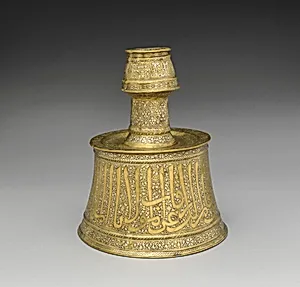
This elegant brass candlestick, crafted in the first half of the 14 century, exemplifies the pinnacle of Islamic metalworking artistry from the medieval Islamic world. Standing 13 inches tall with a broad base of 11⅛ inches in diameter, it was designed to hold a candle securely, likely for illuminating grand mosques, palaces, or scholarly gatherings. The unknown artisan's mastery shines through the intricate silver inlays— a technique known as damascening or koftgari—where fine silver wires were hammered into meticulously engraved brass surfaces, creating shimmering patterns that catch the light and evoke a sense of opulence. Dating to the Mamluk era (roughly 1250–1517), when Syria and Egypt flourished as centers of luxury crafts, this piece reflects the era's technical innovation and cultural patronage. Brass, abundant and malleable, was favored for its durability, while silver inlays added precious contrast, often depicting arabesques, inscriptions, or geometric motifs symbolizing paradise. Such objects were not mere utilities but status symbols, commissioned by sultans and elites to showcase piety and refinement. Today, housed in the Metropolitan Museum of Art's Islamic Art department as part of the Edward C. Moore Collection (bequeathed in 1891), this candlestick invites us to imagine flickering flames dancing across its surfaces, bridging the sensory worlds of medieval Islam and our own.