
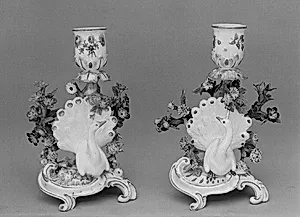
Candlestick (one of a pair)
ca. 1760
Medium
Hard-paste porcelain
Dimensions
Height: 6 in. (15.2 cm)
Classification
Ceramics-Porcelain
Culture
German, Meissen
Department
European Sculpture and Decorative Arts
Museum
Metropolitan Museum of Art, New York, NY
Credit
Bequest of John L. Cadwalader, 1914
Accession Number
14.58.54
Rights
Public Domain
Tags
Art Historical Context
This elegant candlestick, one of a pair crafted by the renowned Meissen Manufactory 1760, exemplifies pinnacle of 18th-century European porcelain artistry. Standing just 6 inches tall, it was fashioned from hard-paste porcelain breakthrough material developed by Meissen in 1710, the first in Europe to replicate the translucent strength of Chinese porcelain. Produced in the German city of Meissen these pieces were prized by aristocracy for their delicate modeling and vibrant polychrome enamels. During the Rococo era, Meissen specialized in whimsical decorative objects like this, often featuring intricate motifs such as birds—evident in the tags associated with this work. The candlestick's form likely incorporates finely sculpted avian elements, showcasing the manufactory's virtuosic techniques in molding, gilding, and overglaze painting. These luxurious items illuminated grand dining tables or boudoirs, blending functionality with opulent ornamentation. Bequeathed to the Metropolitan Museum of Art in 1914 by John L. Cadwalader, this pair reflects Meissen's enduring cultural legacy: symbols of technical innovation and refined taste that bridged Eastern ceramic traditions with Western extravagance. Visitors will appreciate its shimmering surface and lifelike details up close.
About the Artist
Meissen Manufactory · 1710–present
The Meissen Manufactory, established on June 6, 1710, by Augustus the Strong, Elector of Saxony and King of Poland, marked the dawn of true hard-paste porcelain production in Europe. Nestled at Albrechtsburg Castle in Meissen near Dresden, the Royal Polish and Electoral Saxon Porcelain Manufactory arose from alchemical experiments begun in 1708 by physicist Ehrenfried Walther von Tschirnhaus and p...