
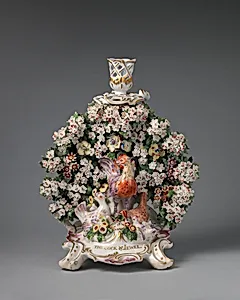
Candlestick (one of a pair)
1769–70
Medium
Soft-paste porcelain
Dimensions
Overall: 10 1/4 × 8 1/4 in. (26 × 21 cm)
Classification
Ceramics-Porcelain
Culture
British, Derby
Department
European Sculpture and Decorative Arts
Museum
Metropolitan Museum of Art, New York, NY
Credit
Gift of Irwin Untermyer, 1964
Accession Number
64.101.523
Rights
Public Domain
Tags
Art Historical Context
This elegant candlestick, one of a pair produced by the renowned Derby Porcelain Manufactory around 1769–70, exemplifies the height of 18th-century British ceramic artistry. Crafted from soft-paste porcelain—a delicate, European imitation of Chinese hard-paste porcelain—its creamy white body stands 10¼ inches tall, perfect for illuminating grand dining tables or drawing rooms of the Georgian elite. Derby, founded in 1750, quickly rose to prominence for its finely modeled figures and ornate decorative wares, blending technical innovation with naturalistic designs. Adorned with lively chickens and roosters, the candlestick captures the Rococo taste for whimsical animal motifs, symbolizing rural vitality and prosperity in British country life. The manufactory's skilled artisans hand-painted and sculpted these birds with remarkable detail, showcasing advances in soft-paste formulas that allowed for thin, translucent walls and vibrant enamels. Though softer and more prone to chipping than later bone china, this medium highlighted Derby's mastery before the recipe's evolution in the 1770s. A generous gift to the Metropolitan Museum of Art in 1964 from Irwin Untermyer, this piece reflects the era's fusion of utility and opulence, inviting visitors to appreciate how porcelain bridged Eastern traditions with Western whimsy.
About the Artist
Derby Porcelain Manufactory · 1751–1785
The Derby Porcelain Manufactory stands as one of the foundational institutions of British ceramic art, producing some of the finest figures and tablewares made in England during the eighteenth and early nineteenth centuries. Its origins can be traced to the work of André Planché, a Huguenot immigrant from Saxony who settled in Derby around 1745 and began producing soft-paste porcelain figures and ...