
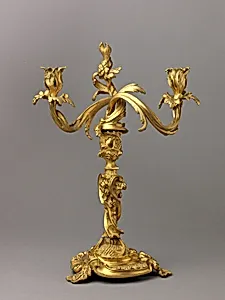
Candlestick with Two Branches
Unknown Artist
ca. 1745–60 or 19th century
Medium
Gilt bronze.
Dimensions
Height: 15 13/16 in. (40.2 cm) Width: 11 3/8 in. (28.9 cm) Diam. of base: 6 3/4 in. (17.1 cm)
Classification
Metalwork-Bronze
Culture
French, Paris
Department
Robert Lehman Collection
Museum
Metropolitan Museum of Art, New York, NY
Credit
Robert Lehman Collection, 1975
Accession Number
1975.1.1476
Rights
Public Domain
Art Historical Context
This elegant *Candlestick with Two Branches crafted in gilt bronze by an unknown Parisian artisan around 1745–60 or possibly in the 19th, exemplifies the refined luxury of French decorative arts. Standing at nearly 16 inches tall with a sturdy 6¾-inch base, its two branching arms were designed to hold candles, casting a warm glow in opulent interiors of the Ancien Régime or later revivals. The uncertain dating reflects ongoing scholarly debate, potentially placing it in the exuberant Rococo era of Louis XV or a neoclassical echo. Gilt bronze, a hallmark of Paris's premier bronziers, involved casting intricate bronze forms and applying a thin layer of gold via mercury-fire gilding—a labor-intensive technique that yielded a radiant, durable finish resistant to tarnish. This medium elevated everyday objects into sculptural masterpieces, blending functionality with artistry and symbolizing wealth and taste among the French elite. Housed in the Robert Lehman Collection at The Metropolitan Museum of Art since 1975, this piece highlights the city's enduring legacy as Europe's metalwork capital. Visitors can appreciate how such candlesticks illuminated salons, flickering against walls adorned with tapestries and mirrors, a testament to craftsmanship that married light, form, and finesse.