
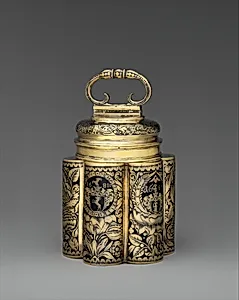
Canister
Unknown Artist
1681
Medium
Gilded silver, enamel
Dimensions
Overall: 6 11/16 x 4 in. (17 x 10.1 cm)
Classification
Metalwork-Silver
Culture
Hungarian, possibly Fogaras
Department
European Sculpture and Decorative Arts
Museum
Metropolitan Museum of Art, New York, NY
Credit
Gift of The Salgo Trust for Education, New York, in memory of Nicolas M. Salgo, 2010
Accession Number
2010.110.39a–c
Rights
Public Domain
Tags
Art Historical Context
This exquisite gilded silver canister, in 1681 by an unknown Hungarian artist—possibly from the Fogaras—exemplifies the lavish metalwork of late 17th-century Central Europe. Measuring just 6 11/16 x 4 inches, its compact form belies its grandeur, with a gleaming surface enriched by gilding and colorful enamel accents. Adorning its body is a prominent coat of arms, a hallmark of noble heraldry that likely marked it as a possession of aristocracy or gentry, used perhaps for storing precious spices, tobacco, or confections. The techniques employed here highlight the era's mastery of silversmithing: gilding applied over silver created a radiant gold-like finish resistant to tarnish, while enamel—fired glass in vibrant hues—added intricate, durable decoration. In the context of Hungarian decorative arts, such pieces reflected the cultural crossroads of Transylvania, blending Ottoman influences with European Baroque opulence amid the Habsburg reconquest. Today, this rare survivor graces the Metropolitan Museum of Art's European Sculpture and Decorative Arts collection, a gift honoring diplomat Nicolas M. Salgo. It offers a tangible glimpse into the splendor of Hungarian elite life, where functionality met heraldic pride.