
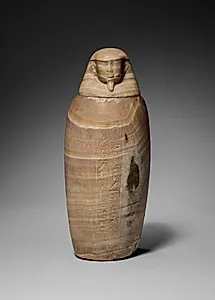
Canopic Jar with Man's Head
Unknown Artist
664–525 BCE
Medium
travertine
Dimensions
h. 38.8 cm · diam. 16.6 cm
Classification
Funerary Equipment
Department
Egyptian and Ancient Near Eastern Art
Museum
Cleveland Museum of Art
Credit
The Charles W. Harkness Endowment Fund
Accession Number
1921.1019
Rights
Public Domain
About this artwork
In the process of mummification, the liver, lungs, stomach, and intestines were removed, separately embalmed, and stored in specialized jars known as canopic jars (after a sailor in Greek mythology, who died at the town of Canopus in the Nile Delta and was worshipped there in the form of a human-headed jar). Each organ was identified with one of four funerary deities collectively known as the Sons of Horus: the liver with Imsety (man's head), the lungs with Hapy (baboon's head), the stomach with...