
Canterbury Pilgrims
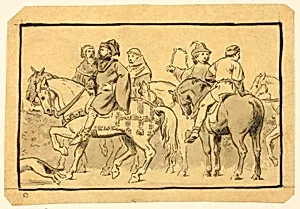
Medium
Pen and black ink, with brush and gray wash and touches of white gouache, over traces of graphite, on tan tracing paper, tipped onto card
Dimensions
10.1 × 14.6 cm (4 × 5 3/4 in.)
Classification
pen and ink drawings
Department
Prints and Drawings
Museum
Art Institute of Chicago
Accession Number
46995
Rights
Public Domain
Art Historical Context
Henry Stacy Marks' *Canterbury Pilgrims* (n.d.) captures the lively spirit of Geoffrey Chaucer's14th-century masterpiece,The Canterbury Tales*. This intimate drawing depicts the motley band of pilgrims journeying to the shrine of Thomas Becket, a timeless English literary scene that resonated in Victorian art. Marks, a prominent 19th-century British painter known for his detailed genre scenes and avian subjects, brings a whimsical touch to this medieval procession, blending historical revival with his era's fascination for narrative storytelling. Executed in pen and black ink with brush and gray wash, plus subtle white gouache highlights over faint graphite underdrawing, the work is on tan tracing paper tipped to card. This mixed-media technique on translucent tracing paper suggests it served as a preparatory study, allowing light to aid composition and transfers. At just 10.1 × 14.6 cm, its compact scale highlights Marks' masterful line work and tonal subtlety, hallmarks of fine pen-and-ink drawings in the Prints and Drawings collection. Housed at the Art Institute of Chicago, this piece reflects the 19th-century Pre-Raphaelite and Romantic interest in medieval themes, offering visitors a window into how artists like Marks reimagined Chaucer's colorful characters—knights, millers, and wives—for modern audiences. A charming gem for literature and art lovers alike!
About the Artist
Henry Stacy Marks · 1829–1898
Henry Stacy Marks (1829–1898) was born on 13 September 1829 in London, the fourth child of coachbuilder John Isaac Marks and Elizabeth Pally. Initially apprenticed in his father's trade and briefly working as a clerk, Marks displayed early artistic talent, learning to paint heraldry for carriages. He began formal training around 1847 at James Mathews Leigh's art school in Newman Street, where he b...