
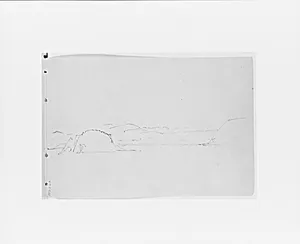
Cape Flattery Landscape (from Sketchbook X)
Medium
Graphite on off-white wove paper
Dimensions
5 x 7 1/2 in. (12.7 x 19.1 cm)
Classification
Drawing
Culture
American
Department
The American Wing
Museum
Metropolitan Museum of Art, New York, NY
Credit
Purchase, Gifts in memory of Stephen D. Rubin, 1992
Accession Number
1992.2.2d recto
Rights
Public Domain
Tags
Art Historical Context
William Trost Richards, a American artist of the Hudson River School captured the rugged beauty of Cape Flattery this intimate graphite sketch from his 1885 Sketchbook X Nestled at the northwestern tip of Washington state's Olympic Peninsula, Cape Flattery offered dramatic coastal vistas—towering cliffs, crashing waves, and misty horizons—that inspired Richards during his travels along the Pacific Northwest. Created amid the late 19th-century fascination with America's wild frontiers, this work reflects the era's Romantic reverence for unspoiled nature, a hallmark of Hudson River School landscapes. Executed in graphite on off-white wove paper, the 5 x 7 1/2-inch sheet showcases Richards' meticulous technique. Wove paper's smooth texture allowed for precise shading and fine lines, enabling quick yet detailed on-site studies that served as references for his larger oil paintings. His Pre-Raphaelite-influenced precision shines through in the delicate rendering of textures, from rocky outcrops to distant seas, emphasizing light, atmosphere, and natural detail over romantic exaggeration. Housed in The Metropolitan Museum of Art's American Wing, this sketch (purchased in 1992 in memory of Stephen D. Rubin) offers a glimpse into an artist's process, bridging fieldwork and studio mastery. It's a testament to Richards' lifelong passion for coastal scenes, inviting visitors to ponder the untamed Pacific through 19th-century eyes.
About the Artist
William Trost Richards · 1833–1905
William Trost Richards (1833–1905) was a prominent American landscape and marine painter born in Philadelphia, where he attended Central High School before beginning his artistic training. Between 1850 and 1855, he studied part-time under the German-born Hudson River School artist Paul Weber while working as a designer and illustrator of ornamental metalwork. He exhibited his first works at the Pe...