
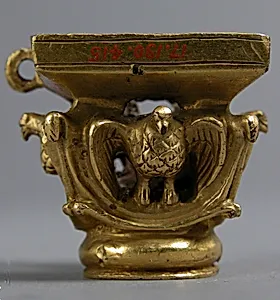
Capital from a Reliquary Shrine
Unknown Artist
1175–1200
Medium
Copper alloy, gilt
Dimensions
Overall: 1 3/16 x 1 5/16 x 1 5/16 in. (3 x 3.4 x 3.3 cm)
Classification
Metalwork-Copper alloy
Culture
German
Department
Medieval Art
Museum
Metropolitan Museum of Art, New York, NY
Credit
Gift of J. Pierpont Morgan, 1917
Accession Number
17.190.415a
Rights
Public Domain
Tags
Art Historical Context
This exquisite *Capital from a Reliquary Shrine*, crafted in Germany between 1175 and 1200, represents the pinnacle of Romanesque metalwork during the High Middle Ages. Reliquary shrines were ornate containers for holy relics—bones or objects associated with saints—venerated in churches to inspire faith and miracles. As a capital, this tiny architectural element crowned a column-like support within such a shrine, blending sculpture and jewelry-like precision in its 3 cm scale. Its German origin reflects the era's vibrant ecclesiastical art, where workshops produced lavish objects to glorify God and attract pilgrims. Fashioned from copper alloy and adorned with gilding—a technique applying a thin gold layer over base metal for a radiant, precious glow—the capital exemplifies medieval innovation in durable, shimmering decoration. Gilt metalwork mimicked gold's sanctity while being more practical for complex forms. Delicate birds, likely symbolic of the soul's ascent or divine messengers, perch amid foliate motifs, showcasing the artist's mastery of engraving and chasing on such a minuscule surface. A gift to the Metropolitan Museum of Art from J. Pierpont Morgan in 1917, this piece offers a window into 12th-century devotion and craftsmanship, reminding us how even small objects held profound spiritual power in medieval life.