
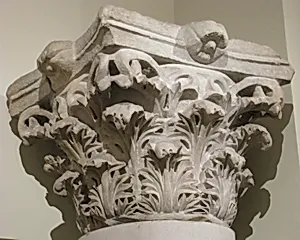
Capital with Acanthus Leaves
Unknown Artist
4th century
Medium
Marble; carved in relief
Classification
Sculpture
Department
Islamic Art
Museum
Metropolitan Museum of Art, New York, NY
Credit
Rogers Fund, 1912
Accession Number
12.181.186
Rights
Public Domain
Tags
Art Historical Context
Behold the **Capital with Acanthus Leaves a masterful marble sculpture from the 4 century, carved in intricate relief by an unknown artist. This element, likely the crowning top of a column, exemplifies Late Antique craftsmanship with its lush, stylized acanthus foliage—a motif rooted in ancient Greek and Roman design. The deeply carved leaves swirl and overlap with naturalistic vigor, creating a sense of organic movement that draws the eye upward, much as it would have in an ancient temple or basilica. Housed in the Metropolitan Museum of Art's Islamic Art Department (acquired via the Rogers Fund in 1912), this capital bridges classical antiquity and later traditions. Acanthus leaves symbolized enduring life and immortality in Greco-Roman art, adorning everything from Corinthian columns to sarcophagi. Their persistence into the 4th century reflects the cultural synthesis of the era, where pagan motifs influenced early Christian and, eventually, Islamic architecture in regions like the Levant and North Africa. Though its exact provenance remains mysterious, this piece invites us to ponder the continuity of artistic motifs across empires. Carved from fine marble, its relief technique—where forms project boldly from the background—highlights the sculptor's skill in capturing light and shadow, making the leaves appear alive even today. A timeless treasure for architecture enthusiasts!