
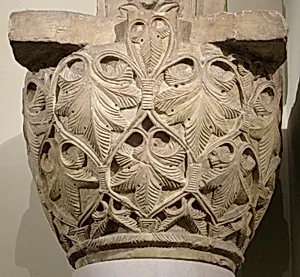
Capital with a Pattern of Leaves and Vines
Unknown Artist
6th–7th century
Medium
Limestone; carved in relief
Dimensions
H. 9 1/16 in. (23 cm) Max. W. 25 9/16 in. (65 cm)
Classification
Sculpture
Department
Islamic Art
Museum
Metropolitan Museum of Art, New York, NY
Credit
Rogers Fund, 1910
Accession Number
10.175.76
Rights
Public Domain
Tags
Art Historical Context
This exquisite limestone capital, carved in relief during the 6th–7th century, showcases a delicate pattern of intertwining leaves and vines. Measuring just over 9 inches high and 26 inches wide at its broadest, it once crowned a column in an early Islamic architectural setting, likely a mosque or palace. The Rogers Fund acquisition in 1910 brought this treasure to the Metropolitan Museum of Art's Islamic Art, where it stands as a testament to masterful stone carving techniques of the era. Dating to the formative years of Islam—spanning the late Byzantine and early Umayyad periods—this capital reflects the cultural synthesis of pre-Islamic traditions from the Mediterranean and Near East. Vegetal motifs like these lush vines and foliage were favored in Islamic art for their evocation of paradise gardens described in the Quran, adhering to aniconic principles that avoided human or animal figures. The intricate relief work, achieved by skilled chiseling to create depth and shadow play, highlights the artisans' precision and the stone's durability for enduring structures. Visitors will appreciate how such capitals adorned sacred and secular spaces, blending functionality with beauty. This piece invites us to imagine the vibrant courts of early caliphal cities like Damascus, where nature's abundance was stylized into eternal elegance.