
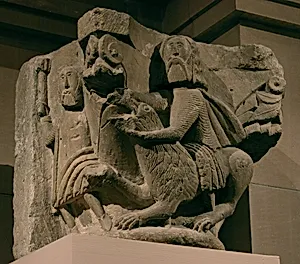
Capital with Samson and an Attendant Fighting a Lion
Unknown Artist
ca. 1175–1200
Medium
Limestone
Dimensions
Overall: 19 3/4 x 20 1/4 x 16 5/8 in. (50.2 x 51.4 x 42.2 cm) weight: 428lb. (194.1kg)
Classification
Sculpture-Architectural
Culture
North Spanish
Department
Medieval Art
Museum
Metropolitan Museum of Art, New York, NY
Credit
Rogers Fund, 1921
Accession Number
21.21.2
Rights
Public Domain
Tags
Art Historical Context
This striking limestone capital, carved around 1175–1200 in Spain, crowns the top of a column in a Romanesque church or cloister. It vividly depicts the biblical hero Samson and an attendant locked in fierce combat with a lion, a scene drawn from the Book of Judges (Judges 14). Measuring about 20 inches across and weighing a hefty 428 pounds, architectural sculpture exemplifies the robust, narrative-driven stonework of medieval monasteries and cathedrals, where capitals served both structural and didactic purposes—teaching Bible stories to largely illiterate congregations. Romanesque art from northern Spain, flourishing during the Reconquista era, often featured dynamic figural carvings like this to convey moral and spiritual lessons. Samson's triumph over the lion symbolized divine strength and foreshadowed Christ's victory over evil, a popular motif in 12th-century sculpture. The unknown artist's skillful low-relief technique animates the figures with twisting bodies and snarling beasts, their compact forms fitting the capital's rounded shape while emphasizing raw power and drama. Acquired by The Metropolitan Museum of Art through the Rogers Fund in 1921, this piece offers a tangible link to Spain's vibrant medieval sculptural tradition, blending functionality with profound storytelling.