
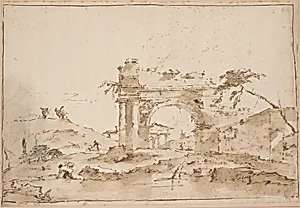
Capriccio with Roman Ruins
18th century
Medium
Pen and brown ink, brush and brown wash, over graphite; framing outlines in pen and brown ink drawn by the artist; sheet glued onto secondary paper support
Dimensions
sheet: 10 7/8 x 15 3/4 in. (27.6 x 40 cm)
Classification
Drawings
Department
Drawings and Prints
Museum
Metropolitan Museum of Art, New York, NY
Credit
From the Collection of Rita and Frits Markus, Bequest of Rita Markus, 2005
Accession Number
2005.330.5
Rights
Public Domain
Tags
Art Historical Context
Francesco Guardi's *Capriccio with Roman Ruins an enchanting 18th-century drawing invites visitors into a dreamlike vision of ancient architecture. Created with pen and brown ink, brush and brown over graphite, this work exemplifies the Venetian master's flair for *capricci*—whimsical compositions blending real ruins, graceful arches, and imagined vistas. At 10 7/8 x 15 3/4 inches, the sheet bears Guardi's own framing outlines in pen and ink, a deliberate touch that enhances its framed, jewel-like quality, later reinforced by gluing onto a secondary support for preservation. Guardi, a leading figure in Venice's late Rococo tradition alongside Canaletto, specialized in atmospheric landscapes that captured the city's light and grandeur while indulging in fantasy. This technique of layered ink washes allowed subtle tonal depths, evoking the Romantic allure of decayed antiquity during Europe's Grand Tour era, when travelers romanticized classical ruins. Such drawings often served as studies for paintings or standalone treasures for collectors. Housed in the Metropolitan Museum of Art's Drawings and Prints department from the Rita and Frits Markus Collection (bequest 2005), it reflects enduring fascination with Guardi's improvisational genius. A perfect gem for pondering how 18th-century artists reimagined history's echoes.
About the Artist
Francesco Guardi · 1712–1793
Francesco Lazzaro Guardi (1712–1793) was born into a noble family of painters from Trentino who had settled in Venice. His father, Domenico Guardi, a minor painter trained in Vienna, died in 1716, leaving young Francesco to inherit the family workshop alongside his brothers Giovanni Antonio (Gian Antonio) and Niccolò, both artists, and sister Maria Cecilia, who married the renowned Giovanni Battis...