
Caprimulgus Ruficollis
1801 to 1825
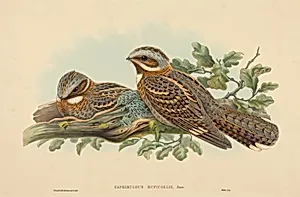
Medium
hand-colored lithograph on wove paper
Dimensions
sheet: 38.6 x 56 cm (15 3/16 x 22 1/16 in.)
Classification
Department
CG-E
Museum
National Gallery of Art, Washington, D.C.
Credit
Collection of Dr. and Mrs. George Benjamin Green
Accession Number
1991.163.53
Rights
Public Domain
Art Historical Context
This hand-colored lithograph depicts the red-necked nightjar (Caprimulgus ruficollis), a nocturnal bird known for its cryptic plumage and distinctive call. Created between 1801 and 1825 by renowned ornithologist and artist John Gould in collaboration with lithographer H.C. Richter, the print exemplifies the golden age of natural history illustration. Gould’s works combined scientific precision with artistic elegance, helping to document and popularize avian species for both scholars and the public during an era of expanding global exploration. The medium of hand-colored lithography was revolutionary for its time, allowing for detailed, reproducible images that captured subtle feather textures and natural postures far more effectively than earlier engraving techniques. Printed on wove paper and measuring roughly 15 by 22 inches, this sheet reflects the high standards of 19th-century scientific publishing. Gould and Richter’s partnership produced thousands of such plates, many appearing in lavish folios like *The Birds of Europe*. Today, the print offers viewers a window into both the bird’s elusive beauty and the artistic methods that advanced ornithological study. Its presence in the National Gallery of Art’s collection highlights the enduring intersection of art and science.
About the Artist
John Gould and H.C. Richter
John Gould (1804–1881) and Henry Constantine Richter (1821–1902) formed one of the most productive and celebrated partnerships in the history of natural history illustration. Gould, an English ornithologist and publisher of extraordinary ambition, built a career on the production of lavishly illustrated folio volumes documenting the birds of Britain, Europe, Australia, Asia, and the Americas. Thou...