
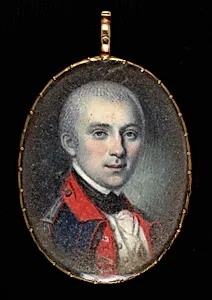
Capt. John Gassoway
ca. 1790
Medium
Painting-Miniature
Classification
Painting-Miniature
Department
Smithsonian Collection
Museum
Smithsonian American Art Museum
Credit
Smithsonian American Art Museum, Bequest of Mary Elizabeth Spencer
Accession Number
1999.27.33
Rights
Public Domain
Tags
About this artwork
Captain John Gassoway (1754-1820), also spelled Gassaway, was wounded and taken prisoner at the disastrous Battle of Camden, fought by Revolutionary forces in South Carolina in 1780. Branches of his family occupy a prominent role in the history of South Carolina, and Anne Arundel County, Maryland. Conservation of this miniature was made possible through a generous grant provided by the Smithsonian Women’s Committee.
Art Historical Context
**Capt. John Gassoway is a delicate miniature portrait painted around 1790 by Charles Willson Peale, one of America's foremost early portraitists and a key figure in the nation's burgeoning art scene. Peale, known for his realistic depictions of Revolutionary War heroes and leaders—including George Washington—captured Captain John Gassoway (1754–1820) in bust form, dressed in his military uniform. This small work, likely rendered in watercolor on ivory, exemplifies the miniature tradition: intimate, jewel-like paintings prized as personal keepsakes or jewelry, often exchanged among family and friends. Gassoway's story adds poignant historical weight. A Maryland officer, he was wounded and captured during the disastrous 1780 Battle of Camden in South Carolina, a crushing defeat for American forces under Horatio Gates. His prominent family branches in Anne Arundel County, Maryland, and South Carolina wove him into the fabric of early American history. Peale's precise brushwork highlights Gassoway's dignified bearing, symbolizing resilience amid the Revolution's trials. Housed in the Smithsonian American Art Museum through the bequest of Mary Elizabeth Spencer, this piece was conserved thanks to the Smithsonian Women's Committee. It invites visitors to ponder the human face of wartime valor in a format that feels remarkably personal. (198 words)
About the Artist
Charles Willson Peale · 1741–1827
Charles Willson Peale (1741–1827) was an American painter, museum founder, naturalist, and inventor who became the most important American portraitist of the Revolutionary era and a central figure in the cultural life of the young republic. Born in Queen Anne's County, Maryland, he initially trained as a saddler before turning to painting, studying briefly with John Singleton Copley in Boston and ...