
竹鶴蒔絵名刺入れ|Card Case with Crane and Bamboo
Unknown Artist
mid-19th century
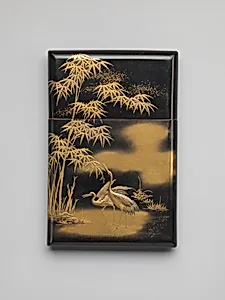
Medium
Black lacquer ground with gold and silver hiramaki-e
Dimensions
H. 2 7/8 in. (7.3 cm); W. 4 3/8 in. (11.1 cm)
Classification
Lacquer
Culture & Period
Japan · Edo period (1615–1868)
Department
Asian Art
Museum
Metropolitan Museum of Art, New York, NY
Credit
Bequest of Stephen Whitney Phoenix, 1881
Accession Number
81.1.346
Rights
Public Domain
Tags
Art Historical Context
This delicate card case, known as *Take Tsuru Maki-e Meishi-ire* (Card Case with Crane Bamboo), hails from Japan's Edo period (1615–1868), a time of relative peace and artistic refinement. Crafted in the mid-19th by an unknown artisan, its compact size—about 2 7/8 by 4 3/8 inches—made it perfect for carrying visiting cards (*meishi*), essential for social and business etiquette among samurai, merchants, and elites. The piece showcases masterful lacquerwork on a black ground, adorned with gold and silver *hiramaki-e*—a technique where finely powdered metals are sprinkled onto wet lacquer and polished to a luminous sheen. Graceful cranes soar amid bamboo stalks, symbols of longevity and resilience in Japanese culture, evoking wishes for prosperity and endurance. This intricate craftsmanship highlights the Edo era's pinnacle of *maki-e* lacquer, blending functionality with poetic beauty. Now in the Metropolitan Museum of Art's Asian Art collection (bequest of Stephen Whitney Phoenix, 1881), this survivor of daily use whispers of Japan's luxurious everyday artistry, where even a humble accessory became a canvas for nature's enduring motifs.