
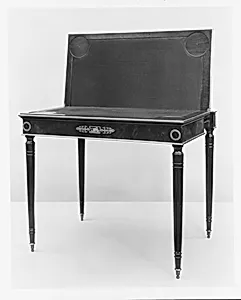
Card table
1805–12
Medium
Mahogany, mahogany veneer, gilded brass with white pine, mahogany
Dimensions
30 x 35 1/4 x 17 1/2 in. (76.2 x 89.5 x 44.5 cm)
Classification
Card table
Culture
American
Department
The American Wing
Museum
Metropolitan Museum of Art, New York, NY
Credit
Rogers Fund, 1946
Accession Number
46.24
Rights
Public Domain
Art Historical Context
This elegant card table, crafted by French-born cabinetmaker Charles-Honor Lannuier between 1805 and 1812, exemplifies the refined Neoclassical furniture produced in early 19th-century America. Lannuier, who emigrated from Paris to Baltimore around 1797, brought sophisticated European techniques to the young republic, blending them with local tastes. Measuring 30 x 35¼ x 17½ inches, this foldable table was designed for genteel social gatherings, where games like whist or loo were popular among the elite. Constructed from rich mahogany with matching veneer, white pine secondary wood, and ornate gilded brass mounts, the piece showcases Lannuier's mastery of veneering and gilding—methods that created a luxurious, mirror-like surface and added a touch of opulence. These materials, imported from the Caribbean and Europe, highlight the transatlantic trade networks fueling America's Federal period prosperity. Housed in The Metropolitan Museum of Art's American Wing and acquired through the Rogers Fund in 1946, this table reflects the cultural aspirations of a new nation emulating classical grandeur. It invites visitors to imagine candlelit parlors alive with conversation and strategy, a snapshot of refined American leisure.