
Card table
1810–15
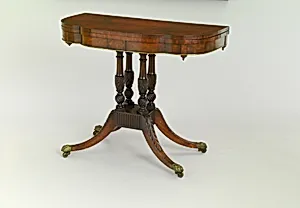
Medium
Mahogany, mahogany veneer, white pine, yellow poplar, rosewood, brass, iron
Dimensions
29 5/8 × 36 × 18 1/2 in. (75.2 × 91.4 × 47 cm)
Classification
Card table
Culture
American
Department
The American Wing
Museum
Metropolitan Museum of Art, New York, NY
Credit
Purchase, Ronald S. Kane Bequest, in memory of Berry B. Tracy, 2018
Accession Number
2018.29.2
Rights
Public Domain
Art Historical Context
Step into the refined world of early 19th-century American with this exquisite card table crafted by Duncan Phyfe around 1810–15. Phyfe, a master cabinetmaker of Scottish origin who rose to prominence in New York City, was renowned for his neoclassical furniture that blended British Regency and French Empire influences. This piece exemplifies his signature style: graceful lines, restrained ornamentation, and superb craftsmanship, making it a hallmark of the Federal period's transition to more opulent Empire tastes. Fashioned primarily from rich mahogany with veneers, white pine, yellow poplar, rosewood, brass, and iron accents, the table's materials reflect the luxury accessible to America's emerging elite. Mahogany, imported from the West Indies, symbolized status, while the folding top—measuring 29 5/8 × 36 × 18 1/2 inches—allowed it to serve double duty as a console against the wall, unfolding for lively card games like whist or loo. Such multifunctional designs were essential in genteel parlors, fostering social bonds amid the young republic's growing prosperity. Housed in The Metropolitan Museum of Art's American Wing, this table (purchased in 2018 via the Ronald S. Kane Bequest) offers a tangible glimpse into antebellum domestic life, where furniture like Phyfe's bridged European sophistication with American ingenuity. A true conversation starter for visitors!
About the Artist
Duncan Phyfe · 1770–1854
Duncan Phyfe (1770–1854) was a Scottish-born American cabinetmaker who became the most celebrated furniture maker in the history of American decorative arts. Born Duncan Fife near Loch Fannich in the Scottish Highlands, he emigrated with his family to Albany, New York, around 1783–84, where he apprenticed to a cabinetmaker. By 1792 he had established his own workshop on Partition Street (later Ful...