
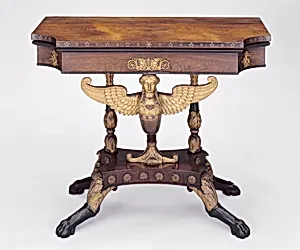
Card Table
c. 1815
Medium
Mahogany with rosewood veneer, giltwood, brass and ebony inlay, ormolu
Dimensions
74.9 × 91.1 × 45.1 cm (29 1/8 × 35 7/8 × 17 3/4 in.)
Classification
table
Department
Arts of the Americas
Museum
Art Institute of Chicago
Accession Number
135533
Rights
Public Domain
About this artwork
Trained as a cabinet-maker in Paris, Charles-Honoré Lannuier arrived in New York in 1803 at the age of twenty-four. His older brother was already well established as the owner of a successful confectionary shop on Broadway and from there the young furniture maker first advertised his services to all potential clients who desired furniture in the “latest French fashion.” Early-nineteenth-century America was much enamored with French taste, and Lannuier successfully catered to his upscale clientel...
Art Historical Context
This elegant card table, crafted around 1815 by Charles-Honoréuier, exemplifies theulent Empire style that bridged French sophistication with early American luxury. Lannuier, a master Parisian cabinetmaker who emigrated to Baltimore in the 1790s, catered to the elite in Washington, D.C., and beyond, furniture for figures like First Lady Dolley Madison. Measuring about 75 x 91 cm when open, this fold-top table was designed for fashionable card games, a social pastime among the emerging American aristocracy during the post-War of 1812 era. The table's mahogany frame, veneered in exotic rosewood, is adorned with intricate brass and ebony inlays, giltwood accents, and gleaming ormolu mounts—techniques borrowed from Napoleonic France that signified wealth and refinement. These materials, often imported at great cost, highlight Lannuier's virtuoso skill in marquetry and gilding, transforming functional furniture into sculptural art. In the Arts of the Americas collection at the Art Institute of Chicago, it stands as a rare survivor of his workshop, offering a glimpse into how neoclassical grandeur shaped the young republic's domestic splendor.