
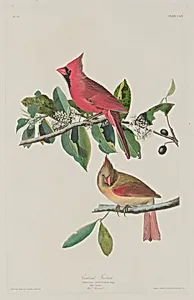
Cardinal Grosbeak
Medium
hand-colored engraving and aquatint on Whatman wove paper
Dimensions
plate: 49.2 x 31.1 cm (19 3/8 x 12 1/4 in.) sheet: 99.7 x 67.3 cm (39 1/4 x 26 1/2 in.)
Classification
Department
CG-W
Museum
National Gallery of Art, Washington, D.C.
Credit
Gift of Mrs. Walter B. James
Accession Number
1945.8.159
Rights
Public Domain
Art Historical Context
"Cardinal Grosbeak," a stunning hand-colored engraving and aquint from 1833, exemplifies the natural history art of John James Audubon, rendered by master printer Robert Havell Jr. This plate is from Audubon's magnum opus, *The Birds of America*, a lavish double-elephant folio between 1827 and 1838. Audubon's innovative approach depicted birds at life size in dynamic, naturalistic poses amid their habitats, revolutionizing ornithological illustration and blending science with artistry. Havell's meticulous translation from Audubon's watercolor originals captured every feather's detail on Whatman wove paper, prized for its durability and fine texture. The medium's significance lies in its aquatint technique, which allowed subtle tonal gradations for lifelike shading, enhanced by expert hand-coloring to evoke the vibrant plumage of the male Cardinal Grosbeak—its scarlet crest and bold black accents popping against a woodland backdrop. Measuring nearly 40 by 27 inches on the sheet, these prints were subscription luxuries for elite collectors, symbolizing 19th-century fascination with American wilderness and scientific discovery. Today, housed in the National Gallery of Art as a gift from Mrs. Walter B. James, this work highlights Audubon's enduring legacy: over 200 years later, *The Birds of America* remains one of the world's most celebrated—and valuable—artistic achievements, bridging art, nature, and exploration.
About the Artist
Robert Havell after John James Audubon
Robert Havell Jr., born on November 25, 1793, in Reading, Berkshire, England, was the son of renowned engraver and publisher Robert Havell Sr. and Lydia Miller Phillips. Growing up in a family of artists that included notable engravers and etchers, he trained under his father, mastering aquatint techniques early on. Though briefly estranged from the family business, Havell reconciled with his fath...