
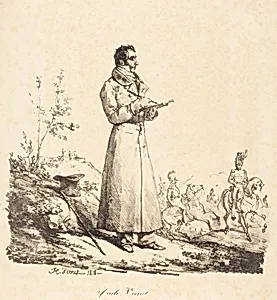
Carle Vernet, Full-Length
1818
Medium
lithograph
Classification
Department
CG-E
Museum
National Gallery of Art, Washington, D.C.
Credit
Rosenwald Collection
Accession Number
1950.16.262
Rights
Public Domain
Art Historical Context
In the National Gallery of Art's Rosen Collection, *Carle Vernet, Full* (1818) is a lithograph by Horace Vernet, capturing his father, the renowned French painter Antoine Charles-Horace Vernet (known as Carle Vernet This full-length portrait showcases Carle in a dignified pose, reflecting the era's fascination with prominent artists and their legacies. Created during France's Bourbon Restoration following the Napoleonic Wars, it embodies the transition from revolutionary fervor to a renewed emphasis on classical grandeur and personal heroism in art. Lithography, the innovative medium here, was a relatively new technique invented just two decades earlier. Horace Vernet drew directly onto a lithographic stone with greasy crayon, allowing for fluid, painterly lines and tonal effects that mimicked drawing—revolutionary for affordable print reproduction. As a master of Romantic history painting and equestrian scenes, Horace honored his father's similar style, known for vivid battle and horse portraits that influenced generations. This print not only highlights a father-son artistic dynasty but also underscores lithography's role in democratizing art access. Visitors will appreciate its technical finesse and intimate familial tribute, a window into early 19th-century French cultural life. (198 words)
About the Artist
Horace Vernet · 1789–1863
**Horace Vernet** (full name Émile Jean-Horace Vernet) was a leading French painter of the nineteenth century, renowned for his dynamic battle scenes, portraits, and Orientalist subjects. Born on 30 June 1789 in Paris at the Louvre during the French Revolution, he came from a distinguished artistic dynasty. He was the son of the equestrian and military painter Carle Vernet and the grandson of the ...