
Carpet
Unknown Artist
probably late 18th–early 19th century
Medium
Wool (warp, weft, and pile); symmetrically knotted pile
Dimensions
L. 74 1/4 in. (188.6 cm) W. 64 in. (162.6 cm)
Classification
Textiles-Rugs
Department
Islamic Art
Museum
Metropolitan Museum of Art, New York, NY
Credit
Gift of Mr. and Mrs. Reginald P. Rose, 1959
Accession Number
59.148
Rights
Public Domain
Art Historical Context
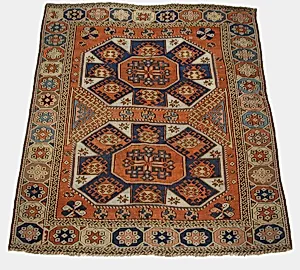
This stunning wool carpet, likely woven in the late 18th early 19th century exemplifies the masterful textile traditions of the Islamic world. Housed in the Metropolitan Museum of Art's Department Islamic Art, it measures an impressive 74¼ by 64 inches (188.6 by 162.6 cm), making it a versatile piece suitable for prayer, floor covering, or wall hanging in a traditional home or mosque. Such rugs were prized possessions, reflecting the wealth and piety of their owners during a period when Ottoman, Persian, and Caucasian weaving centers flourished. Crafted entirely from wool—for warp, weft, and densely piled surface—the carpet employs the symmetrically knotted pile technique, also known as the Turkish or Ghiordes knot. This method, where knots are mirrored across the weave, creates exceptional durability and a lustrous sheen, allowing intricate patterns to emerge with remarkable precision. Weavers spent months or years perfecting these designs, often drawing from floral motifs, geometric forms, or medallions symbolic of paradise gardens in Islamic cosmology. Generously gifted to the Met in 1959 by Mr. and Mrs. Reginald P. Rose, this anonymous masterpiece invites visitors to ponder the anonymous artisans whose skill elevated everyday wool into enduring art. Step closer and imagine it gracing a divan in a bustling bazaar-era interior!