
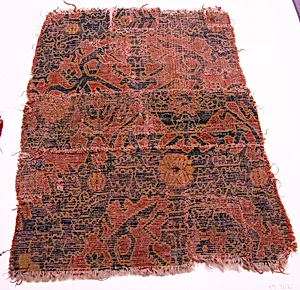
Carpet Fragment
Unknown Artist
15th–16th century
Medium
Wool (warp, weft and pile); single-warp (Spanish) knotted pile
Dimensions
L. 23 3/4 in. (60.3 cm) W. 17 3/4 in. (45.1 cm)
Classification
Textiles-Rugs
Department
Islamic Art
Museum
Metropolitan Museum of Art, New York, NY
Credit
Gift of Joseph V. McMullan, 1957
Accession Number
57.150.2
Rights
Public Domain
Art Historical Context
This exquisite carpet fragment, dating to the 15th–16th century, hails from the Islamic Art collection at the Metropolitan Museum of Art A generous gift from Joseph V.Mullan in 1957, it measures just 23¾ × 17¾ inches (60.3 × 45.1 cm), offering a tantalizing glimpse into the opulent textile traditions of medieval Islamic Spain. During this era, following centuries of Muslim rule in Al-Andalus, skilled weavers produced rugs that blended intricate designs with durable craftsmanship, often exported across Europe where they adorned royal courts and churches. Crafted entirely from wool—for warp, weft, and pile—the fragment showcases the distinctive single-warp (Spanish) knotted pile technique. This method, unique to Iberian Islamic production, involves tying individual knots around single warps, creating a dense, resilient pile ideal for heavy use on floors or walls. Such carpets symbolized wealth and piety, their motifs typically featuring geometric patterns, floral motifs, or arabesques that reflected Islamic aniconism and mathematical precision. Though incomplete, this piece highlights the technical mastery of anonymous artisans whose work bridged cultures, influencing Renaissance Europe. Visitors can appreciate how these textiles wove together artistry, utility, and cultural exchange in a vibrant historical tapestry.