
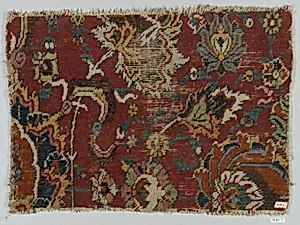
Fragment of a Floral Carpet
Unknown Artist
16th century
Medium
Silk (warp), wool (weft and pile); asymmetrically knotted pile
Dimensions
H. 11 in. (27.9 cm) W. 15 3/4 in. (40 cm)
Classification
Textiles-Rugs
Department
Islamic Art
Museum
Metropolitan Museum of Art, New York, NY
Credit
Rogers Fund, 1919
Accession Number
19.81.1
Rights
Public Domain
Art Historical Context
This exquisite *Fragment of a Floral Carpet from the 16th offers a glimpse into the opulent world of Islamic textile artistry. Housed in the Metropolitan Museum of Art's Department Islamic Art, this small yet vibrant piece (11 x 15¾ inches) showcases intricate floral motifs typical of the period, likely woven in a workshop in the Ottoman Empire or Safavid Persia, where carpets were prized symbols of wealth and refinement. Crafted with a silk warp for a fine, lustrous foundation and wool weft and pile for durability and rich color, the carpet employs an asymmetrically knotted pile technique—a hallmark of Persian weaving traditions. This method allows for exceptional detail and density, enabling weavers to create flowing, naturalistic designs that evoke blooming gardens, a motif deeply rooted in Islamic decorative arts symbolizing paradise. Though only a fragment survives, it highlights the technical mastery and cultural prestige of 16th-century rug production, acquired through the Rogers Fund in 1919. Visitors can appreciate how such textiles adorned palaces and mosques, blending artistry with everyday luxury in the Islamic world.