
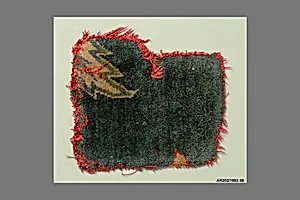
Carpet Fragment
Unknown Artist
17th century
Medium
Silk (warp and weft), wool (pile); asymmetrically knotted pile
Dimensions
H. 4 in. (10.2 cm) W. 3 1/4 in. (8.3 cm)
Classification
Textiles-Rugs
Department
Islamic Art
Museum
Metropolitan Museum of Art, New York, NY
Credit
Gift of Nanette Rodney Kelekian, 1982
Accession Number
1982.98
Rights
Public Domain
Art Historical Context
This exquisite carpet fragment, hailing from the 17th century and housed in the Metropolitan Museum of Art's Department of Islamic Art, offers a tantalizing glimpse into the opulent world of Islamic textile artistry. Though created by an unknown artist, diminutive size—measuring just 4 by 3¼ inches—belies the grandeur it once represented, likely part of a larger floor covering or wall hanging prized by elites in the Islamic world, such as Persia or the Ottoman Empire. Crafted with silk warp and weft for a fine, lustrous foundation and wool pile for durability and rich color, the fragment showcases the asymmetrically knotted pile technique. This method, characteristic of Persian weaving traditions, allows for intricate patterns and sharper curves than the symmetric knots favored in Turkish rugs. Knotting thousands of these tiny loops by hand demanded extraordinary skill, reflecting the labor-intensive mastery of weavers who blended functionality with aesthetic splendor. As a gift from Nanette Rodney Kelekian in 1982, this piece highlights the cultural prestige of Islamic carpets, symbols of wealth, piety, and paradise gardens in motifs. Even in fragment form, it invites visitors to marvel at the enduring legacy of these textiles, bridging centuries of craftsmanship and storytelling through thread.