
Carte photographique de la lune, planche II (Photographic Chart of the Moon, plate II)
March 15, 1902, printed 1914
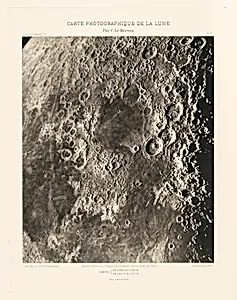
Medium
photogravure with ink on tissue paper overlay
Dimensions
image: 31.1 × 25.5 cm (12 1/4 × 10 1/16 in.) plate: 38.9 × 29.5 cm (15 5/16 × 11 5/8 in.) sheet: 49 × 37.9 cm (19 5/16 × 14 15/16 in.) tissue: 42.55 × 37.47 cm (16 3/4 × 14 3/4 in.)
Classification
Photograph
Department
CPH
Museum
National Gallery of Art, Washington, D.C.
Credit
Pepita Milmore Memorial Fund
Accession Number
2018.22.1.2
Rights
Public Domain
Art Historical Context
**Carte photographique de la, planche II** by Charles le Morvan the moon's cratered surface in exquisite detail, dated March 15, 1902, and printed in 1914. This, part of a series of photographic lunar charts, reflects the era's fascination with celestial mapping, when astronomers relied on earthbound telescopes to document the moon's topography before space exploration. Le Morvan, a skilled in astronomical photography, contributed to the visual documentation of the cosmos at a time when such images bridged scientific inquiry and artistic precision. The work's medium—photogravure with ink on tissue paper overlay—highlights innovative printing techniques of the early 20th century. Photogravure, a photomechanical intaglio process, allowed for rich tonal gradations and fine details, making it ideal for reproducing astronomical photographs with remarkable fidelity. The delicate tissue overlay, lightly inked, likely enhanced contrast or added subtle coloration, inviting viewers to appreciate the moon's rugged beauty up close. Measuring about 31 x 25 cm in its image area, this piece from the National Gallery of Art's collection (acquired via the Pepita Milmore Memorial Fund) exemplifies how photography elevated scientific observation into gallery-worthy art. Today, it reminds us of humanity's enduring gaze skyward, blending Le Morvan's technical mastery with the wonder of discovery.
About the Artist
Charles le Morvan
Charles Le Morvan (1865–1932), born Charles Marie Le Morvan in Pleubian, Brittany, emerged as a pivotal figure in the dawn of astronomical photography during the late nineteenth and early twentieth centuries. Joining the Paris Observatory staff in 1890, he worked as an assistant to astronomers Maurice Loewy and Pierre Puiseux, contributing essential photographic observations and glass plate prepar...