
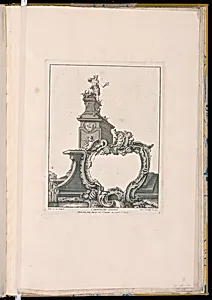
Cartouche decoré
1743-1763
Medium
Classification
Department
Smithsonian Collection
Museum
Smithsonian American Art Museum
Credit
Purchased for the Museum by the Advisory Council
Accession Number
1921-6-231-14
Rights
Public Domain
About this artwork
Research in Progress
Art Historical Context
**Cartouche Décoré** by Pierre Edme Babel (French, 1720–1775) is an exquisite 18th-century print created between 1743 and 1763. As a master engraver working in the lavish Rococo style, Babel specialized in ornamental designs that captured the playful elegance of Louis XV's France. This piece, now in the Smithsonian American Art Museum's collection (purchased by the Advisory Council), exemplifies the era's fascination with decorative frames known as cartouches—scroll-like enclosures often used to highlight titles, maps, or architectural elements. Cartouches like this one were more than mere decoration; they embodied Rococo's whimsical asymmetry, intricate flourishes, and natural motifs such as shells, foliage, and mythical figures. Babel's print technique allowed for precise line work and tonal depth, making complex designs reproducible for architects, furniture makers, and book illustrators. These prints democratized high-style ornamentation, influencing interiors across Europe. Though research on this specific work continues, *Cartouche Décoré* offers a window into Babel's contributions to decorative arts, bridging fine art and everyday luxury in the opulent mid-1700s. Visitors will appreciate its delicate craftsmanship, a testament to printmaking's role in spreading Rococo splendor. (178 words)