
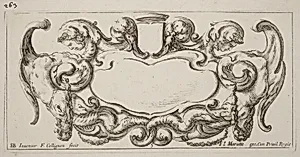
Cartouche
probably 1646
Medium
etching
Classification
Department
CG-E
Museum
National Gallery of Art, Washington, D.C.
Credit
Rosenwald Collection
Accession Number
1944.5.166
Rights
Public Domain
Art Historical Context
Welcome to the National Gallery of Art, where we encounter *Cartouche*, a delicate etching by François Collignon the design of Stefano della Bella, likely created around 1646. This print exemplifies the collaborative spirit of 17th-century European printmaking, with Collignon faithfully reproducing della Bella's intricate ornamental motif. A "cartouche" refers to an elegant, scroll-like frame often used in architecture and decorative arts to enclose inscriptions, coats of arms, or emblems—think of it as a Baroque flourish adding grandeur to grand designs. Stefano della Bella, a masterful Italian etcher active in Florence and Paris, was renowned for his lively depictions of festivals, landscapes, and fantasies, blending whimsy with precision. Collignon, a French engraver, specialized in such reproductive prints, making high-quality designs accessible to collectors and artisans across Europe. Etching, the medium here, involved drawing into a wax ground on a copper plate with acid selectively biting lines for rich, expressive tones—perfect for capturing the cartouche's swirling curves and fine details. Part of the esteemed Rosenwald Collection, this work highlights printmaking's role in disseminating decorative motifs during the Baroque era, influencing everything from book illustrations to furniture inlays. It's a testament to how prints bridged courts and workshops, preserving artistic elegance for generations. Pause and admire the technical virtuosity—della Bella's vision lives on through Collignon's skilled hand!