
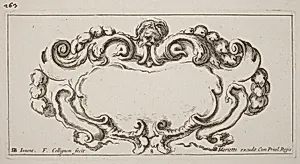
Cartouche
probably 1646
Medium
etching
Classification
Department
CG-E
Museum
National Gallery of Art, Washington, D.C.
Credit
Rosenwald Collection
Accession Number
1944.5.168
Rights
Public Domain
Art Historical Context
Welcome to the National Gallery of Art, where we spotlight *Cartouche*, an exquisite etching by François Collignon after Stefano della Bella, likely created around 1646. This print belongs to the Rosenwald in the CG-E Department, exemplifying the refined reproductive techniques of 17th-century Europe. Della Bella, a masterful Italian Baroque printmaker renowned for his intricate depictions of festivals, architecture, and ornamentation, provided the original design, while Collignon, a skilled French engraver, faithfully captured its elegance through etching—a process using acid to bite fine lines into a metal plate, allowing for delicate, expressive details. A cartouche, as seen here, is an ornate, often oval-shaped frame traditionally used in architecture, manuscripts, and decorative arts to enclose inscriptions, coats of arms, or motifs. Popular during the Baroque era, these designs symbolized grandeur and were widely copied for use in book illustrations, furniture, and wall panels, reflecting the period's love for elaborate embellishment amid the opulence of courts like those of Louis XIV. This work highlights the collaborative spirit of printmaking, where artists like Collignon disseminated influential Italian motifs across Europe, influencing design trends. Its preservation in the National Gallery underscores etching's role in preserving ephemeral ornamental ideas, inviting us to appreciate the artistry in everyday decoration. (198 words)