
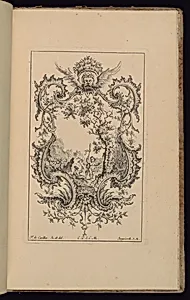
Cartouche with Putti in Landscape
Classification
Bound print
Department
Smithsonian Collection
Museum
Smithsonian American Art Museum
Credit
Purchased for the Museum by the Advisory Council
Accession Number
1921-6-281-88
Rights
Public Domain
About this artwork
Research in Progress
Art Historical Context
**Cartouche with Putti Landscape** (1738) is a delightful bound print by François de Cuvilliés the Elder, Belgian-born architect and designer who became a leading figure in Germany's Rococo movement. Active primarily in Munich at the Bavarian court,uvilliés (1695–1768) rose from humble origins—discovered as a dwarf in the Spanish Netherlands—to serve as chief court architect for Elector Maximilian III Joseph. His works graced opulent spaces like the Amalienburg pavilion at Nymphenburg Palace, blending French-inspired elegance with playful ornamentation. This piece features a cartouche—an ornate, scroll-like frame—adorned with frolicsome putti (chubby, winged cherubs) amid a lush landscape, embodying Rococo's whimsical spirit. As a bound print, it likely hails from one of Cuvilliés's influential *livres d'ornements* (ornament books), which disseminated decorative motifs to artisans across Europe. These prints served as pattern books for stucco, silverwork, and furniture, showcasing his mastery of intricate linework and asymmetry. Held in the Smithsonian American Art Museum's collection (purchased by the Advisory Council), this work highlights the transatlantic flow of European design influences into American collections. Though research continues, it invites visitors to appreciate Rococo's joyful exuberance and Cuvilliés's enduring legacy in decorative arts. (198 words)