
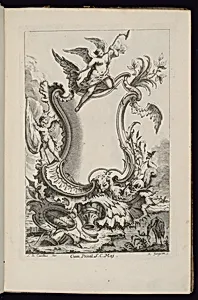
Cartouche with Triumph
Medium
Bound print
Classification
Bound print
Department
Smithsonian Collection
Museum
Smithsonian American Art Museum
Credit
Purchased for the Museum by the Advisory Council
Accession Number
1921-6-281-10
Rights
Public Domain
About this artwork
Research in Progress
Art Historical Context
François de Cuvilli the Elder (1695–1768), a Belgian-born artist who rose to prominence in Germany, a master of Rococo design, blending exuberant ornamentation with playful elegance. Active at the Bavarian court in Munich, he served as court architect and designer, creating lavish interiors like those at Nymphenburg Palace. *Cartouche with Triumph* (8) exemplifies his flair for decorative motifs, likely featuring an ornate cartouche—an oval or scroll-shaped frame often enclosing inscriptions, coats of arms, or allegorical scenes of victory and celebration. As a bound print from the Smithsonian American Art Museum's collection, this work reflects the era's innovative use of printmaking to disseminate architectural and ornamental designs across Europe. Bound prints, typically gathered into albums, allowed artisans, architects, and patrons to study and replicate intricate patterns, fueling the Rococo's widespread influence. Cuvilliés produced numerous such pattern books, making complex motifs accessible and spurring a golden age of embellished furniture, walls, and silverwork. Though research on this piece continues, it captures the Rococo spirit of joy and theatricality amid Europe's Enlightenment courts, inviting us to appreciate how a simple frame could symbolize grandeur and triumph. Purchased for the museum by the Advisory Council, it preserves a slice of 18th-century design ingenuity.