
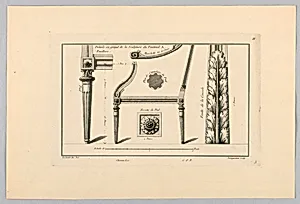
Carved Details for Armchair
18th century
Classification
Department
Smithsonian Collection
Museum
Smithsonian American Art Museum
Credit
Gift of Eleanor and Sarah Hewitt
Accession Number
1931-94-513
Rights
Public Domain
About this artwork
Research in Progress
Art Historical Context
In the opulent world of 18th-century French decorative arts, Richard de Lalonde stands out as a skilled designer active from 1780 to 1796, capturing the refined Neoclassical aesthetic that defined the late Louis XVI era. His *Carved Details for Armchair*, a print from this period, showcases intricate ornamental motifs intended for high-end furniture. These designs reflect the era's fascination with classical antiquity—think symmetrical garlands, urns, and acanthus leaves—blending elegance with structural precision for armchairs destined for aristocratic salons. As a print, this work served a practical purpose: disseminating detailed patterns to ébénistes (cabinetmakers) across Europe, revolutionizing furniture production through reproducible blueprints. Though the exact medium remains unidentified amid ongoing research, such prints were vital tools in the collaborative craft of luxury goods, bridging artistry and industry during a time of social upheaval just before the French Revolution. Now part of the Smithsonian American Art Museum's collection, gifted by collectors Eleanor and Sarah Hewitt, this piece highlights transatlantic exchange in design history. It invites us to imagine the tactile splendor of a fully carved armchair, whispering of vanished grandeur while research continues to uncover more about Lalonde's legacy.