
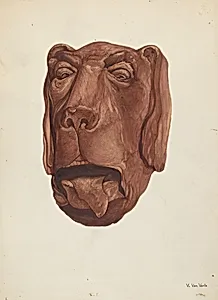
Carved Dog's Head
c. 1937
Medium
watercolor, graphite, and pen and ink on paper
Dimensions
overall: 30.2 x 21.9 cm (11 7/8 x 8 5/8 in.) Original IAD Object: 7 3/4" high; 5 5/8" wide; 5 3/4" deep
Classification
Index of American Design
Department
CG-W
Museum
National Gallery of Art, Washington, D.C.
Credit
Index of American Design
Accession Number
1943.8.8245
Rights
Public Domain
Art Historical Context
**Carved Dog's Head** by Vera Van Voris, created around 1937, captures the whimsical charm of an American folk art carving in exquisite detail. This small-scale sculpture—measuring just 7¾ inches high, 5⅝ inches wide, and 5¾ inches deep—likely represents a hand-carved wooden dog's head, evoking the playful animal motifs common in early American craftsmanship. Van Voris's rendering on paper (30.2 × 21.9 cm) brings the three-dimensional object to life through delicate watercolor washes, precise graphite outlines, and fine pen-and-ink hatching, highlighting textures from fur to carved contours. As part of the *Index of American Design* (IAD), a groundbreaking WPA Federal Art Project from 1935–1942, this work documents everyday American folk art during the Great Depression. Artists like Van Voris produced over 18,000 meticulous plates to preserve cultural heritage, blending artistic skill with anthropological accuracy. Housed in the National Gallery of Art's collection, it showcases how ordinary objects like this carved dog's head reflected regional woodcarving traditions, possibly from whittlers in rural communities. Today, it invites us to appreciate the ingenuity of anonymous makers and the IAD's role in elevating folk art to national treasure status—reminding visitors of America's vibrant, handmade past.
About the Artist
Vera Van Voris
Vera Van Voris is an artist whose works have been preserved in museum collections in sufficient number to indicate a serious and sustained artistic practice, even though her biographical details — birth and death dates, nationality, and the particulars of her training — remain undocumented in the standard art-historical literature. Her distinctive name suggests possible Dutch or Central European h...